Making cost potential visible
Should Costing Calculation
Determine what products and services should really cost.
With costdata's should-costing calculation, you get a reliable, data-based foundation for target prices, bid evaluations, and informed negotiations—supported by our own software, expertise, and real market and cost data.
With costdata's should-costing calculation, you get a reliable, data-based foundation for target prices, bid evaluations, and informed negotiations—supported by our own software, expertise, and real market and cost data.
Data-based bottom-up should-cost analyses
Integration of real market data
Customized should costing methods
Quality and reliability for top companies













.svg)













Transparency instead of assumptions
Should costing for realistic target prices
For more than 25 years, costdata has been helping companies determine sound target prices for products and services. The focus is not on the offer price, but on the question: What should a product cost under realistic market conditions? Our should-costing calculation is based on a combination of our own software, current market and cost data, and in-depth process and manufacturing expertise. Technical drawings, parts lists, and production-related parameters form the basis for reliable bottom-up analyses. On this basis, we identify cost-relevant drivers, objectively evaluate offer and target prices, and derive concrete measures for sustainable cost optimization—from design to procurement.
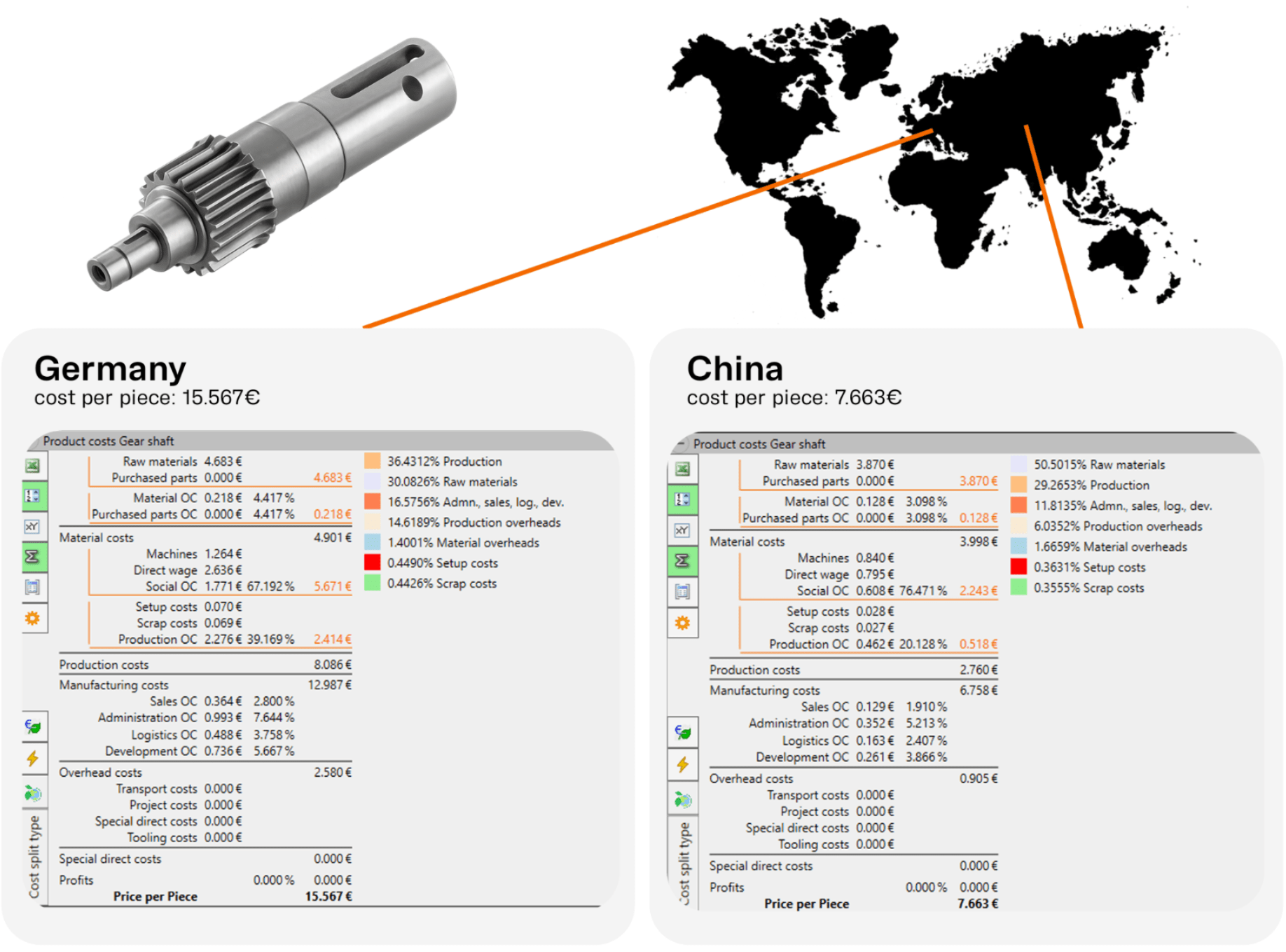
The decisive added value
Why should costing with costdata is so resilient
The validity of a should-costing calculation stands and falls with its database. This is exactly where costdata comes in: our analyses combine our own software with real market, cost, and location data as well as sound methodological expertise. Instead of theoretical assumptions, realistic target costs are created that are based on actual production and market conditions. Supplemented by our consulting services, this produces reliable results that are not only convincing in mathematical terms, but also hold up in price negotiations and decision-making processes.
Own market and cost data
For decades, costdata has been building up its own continuously maintained database. This includes international benchmarks for wages, personnel costs, machine hourly rates, material prices, location costs, and overhead cost structures.
The data is updated regularly and reflects real market conditions in various sectors of the manufacturing industry—providing a reliable basis for realistic should-cost assessments.
The data is updated regularly and reflects real market conditions in various sectors of the manufacturing industry—providing a reliable basis for realistic should-cost assessments.
Should Costing Software
Our should-costing software was developed specifically to make complex cost structures transparent and comparable. Flexible calculation modules enable individual calculation logic and can be seamlessly linked to the underlying market and cost data.
This results in fast, traceable, and reliable target costs—tailored to the product, process, and location.
This results in fast, traceable, and reliable target costs—tailored to the product, process, and location.
Experienced should-costing experts
The software is complemented by our interdisciplinary consulting teams with in-depth experience in the fields of metal, plastics, and electronics. Our experts analyze manufacturing processes, cost structures, and technical details holistically and critically review the results.
The result is realistic should-costing calculations that are not only mathematically correct but also convincing from an operational and strategic perspective.
The result is realistic should-costing calculations that are not only mathematically correct but also convincing from an operational and strategic perspective.
Practice from the market
Target costing for competitive products
initial situation
A manufacturer in the DIY sector was confronted with a new competitor product that was exerting considerable price pressure. The goal was to quickly understand the cost level at which the market operates—and which target prices are realistically achievable.
Our approach
As part of a should-costing analysis, costdata examined the competitor's product in detail. The structured analysis of components, materials, manufacturing processes, and location assumptions resulted in a robust target cost model.
The result
The customer received a transparent basis for decision-making for supplier discussions and was able to position its own product competitively—without jeopardizing its own margin.

“For me, ‘should costing’ means truly understanding products—not just from a technical perspective, but above all from an economic one. Together with our customers, we create transparency regarding cost structures, which enables us to make better, more informed pricing decisions.”
Patrick Diehm
Lead Consulting

Quick start to product costing
Frequently asked questions
What do you need for a should costing analysis?
Step 1:
Signing a mutual NDA (Non-Disclosure Agreement) to ensure the confidentiality of the information.
Step 2:
Provision of detailed information
- 3D or 2D data (if not available, access to the physical component).
- Material and weight specifications, unless evident from component or documents.
- Country of manufacture and exact region.
- Estimates of manufacturer sales at the production site.
- Annual total number of units and product life, possibly also average batch size or call-off quantity.
- Should packaging, transport and customs costs be taken into account? Is there information on the packaging design and the transport process?
Who uses our should costing calculation?
We work across industries, both manufacturing and services. We calculate metal, plastic, glass, wood, ceramics, electronic components as well as services from window cleaning to hairdressing.
For which companies is should-cost analysis particularly interesting?
- Companies without their own cost engineering department, e.g. smaller companies or those that rarely charge costs. In these cases, licenses for data and software are unsuitable.
- Companies that want to compare their own calculation with an external one, or that use an alternative solution internally.
- Companies whose resources in the area of product costing have already been exhausted.
- Companies that do not have expertise in evaluating machines and manufacturing processes.
When is the ideal time for a should-cost analysis?
Costs are incurred throughout the entire product life cycle. In product development, the cost influence is greatest, as no production costs are incurred yet. Even if parts production is already underway, product costing creates transparency and clarity with regard to the cost structure. Cost drivers and savings potential are identified, which is used, for example, to evaluate and review quotation prices.