costdata® calculation
Calculation from a single source
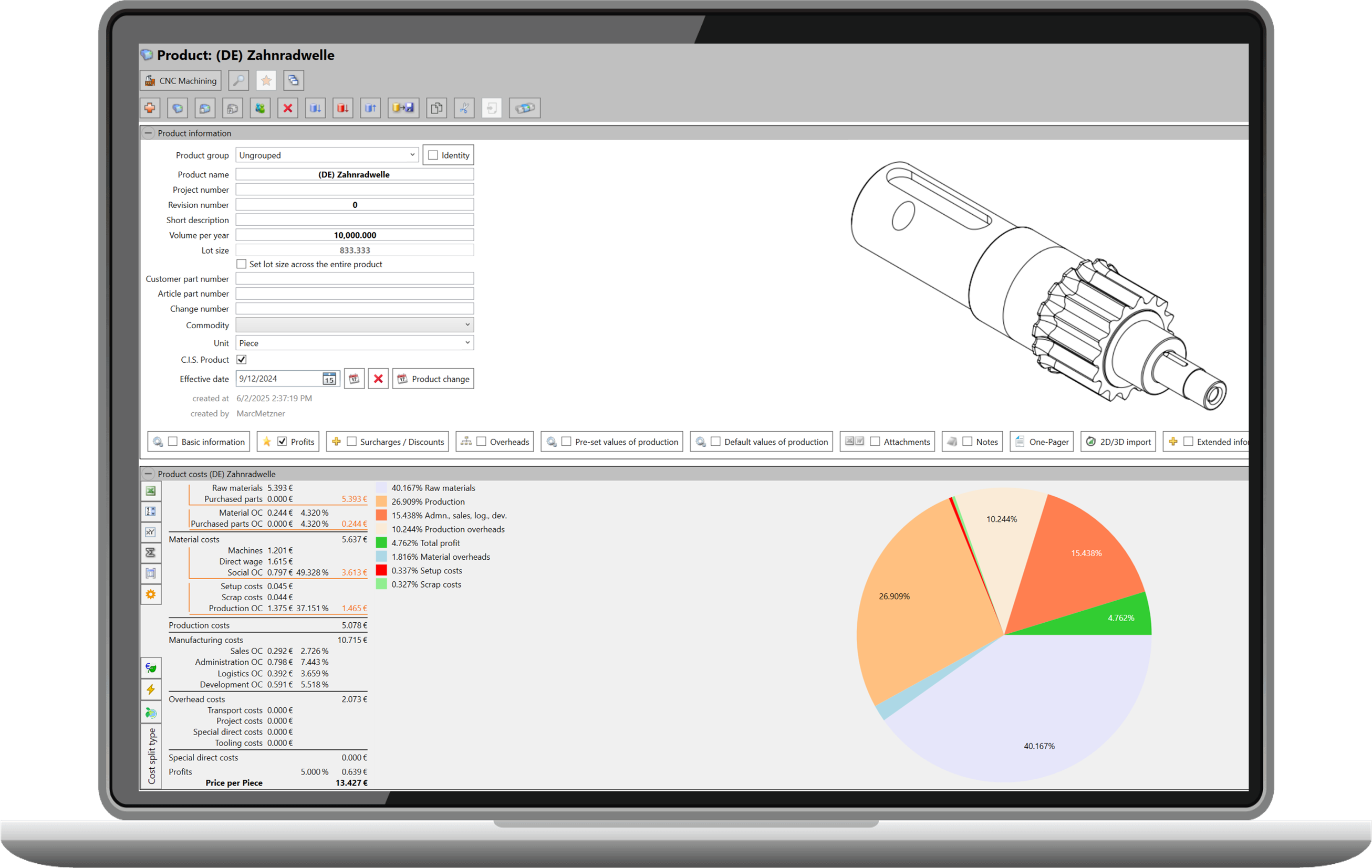
In combination with our data, our costdata® calculation software is one of the world's leading solutions for product cost calculation. It is fast, accurate and intuitive - the optimal decision-making basis for your cost engineering, regardless of the industry.
Quality and reliability for top companies





Bottom-up calculation
Full cost calculation with machine hourly rate
The software calculates product costs quickly, flexibly, and transparently. Various simulations of cost drivers (volumes, cost drivers, and shifts) can be run at the click of a button.
It supports both bottom-up and parametric approaches to cost calculation.
Users can flexibly decide on the level of detail to be included. All results can be transparently tracked.
New and enhanced features tailored to customer needs are implemented every three months.
A maximum of two training sessions is sufficient for getting up to speed.
Pinpoint modules
The most important modules at a glance
With over 25 years of experience, we are experts in developing solutions that give you a competitive edge. We offer electronic component databases, 3D and 2D imports and more.
Should costing software with your own data
Comprehensive should-costing analysis
Many product cost calculations end up as theoretical models or simplified assumptions. costdata deliberately goes one step further: our product cost calculation is designed as a fully-fledged should-costing analysis and combines calculation software with integrated market and cost data.

Everything at a glance
Features
costdata® calculation provides analysis and cost evaluation of components, assemblies, and tools. Various methods and analyses are available for these.
The following manufacturing methods:
- Prototypes (die casting, casting, sintering, injection molding, extrusion, ...)
- Metal forming (forging, rolling, bending, deep drawing, etc.)
- Cutting (punching, shearing, laser cutting/drilling, EDM, machining, drilling, milling, planing, slotting, broaching, sawing, grinding, lapping, spark erosion, cleaning, ...)
- Joining (welding, soldering, riveting, assembling, pressing, vulcanizing, ...)
- Finishing work (deburring, cleaning, cable assembly, testing/quality control, assembly, ...
- Coating (painting, galvanizing, electroplating, spray coating, etc.)
- Change material properties (hardening, annealing, preheating, etc.)
- Other (robots, PU foam molding, cutting, grinding, and washing lines, screen printing, ...)
The following specially developed analyses:
- Cost Driver Analysis (Calculation of Cost Drivers)
- Relocation Analysis (covering over 4,100 regions worldwide)
- Utilization Rate Analysis
- Changes in volume
- Currency Conversion
- Contribution Margin Analysis
- Supplier Analysis
- Overhead coverage
- Product comparison
The following standard analyses:
- Calculation of setup costs
- Calculation of shipping costs
- Cost Variation (Cost Simulation Based on Changes in Input Factors)

Reviewing the production costs of a coffee brand to set new cost targets
A well-known coffee brand reviews its production costs for the coming year and defines new cost targets for purchasing.
Current agricultural commodity prices—especially for coffee beans—are used for coffee capsules. For coffee machines, historical commodity trends in the areas of metal, plastic, and electronics serve as a reference.
With the help of suitable benchmarks, the analysis effort was significantly reduced and ultimately a cost reduction of 7% was achieved.

Development of low-carbon mobile phone cases using injection molding
A company is planning to manufacture low-carbon mobile phone cases using injection molding. To do this, it needs to identify suitable plastics that have a low product carbon footprint and are also cost-effective.
In addition, investments in machinery and production parameters, such as machine cycle times, must be taken into account for the new portfolio.
All planning can be carried out early, in a structured manner, and with just a few clicks—with full transparency and without any loss of information.
In addition, investments in machinery and production parameters, such as machine cycle times, must be taken into account for the new portfolio.
All planning can be carried out early, in a structured manner, and with just a few clicks—with full transparency and without any loss of information.

Price orientation for heating systems through transparent overhead cost analysis
A medium-sized manufacturer of heating systems lacks clear guidance on market-driven sales prices.
Although direct costs are known, overhead costs cannot be clearly allocated to individual products due to a lack of documentation.
Industry-standard overhead surcharges enable the company to regain transparency and provide a reliable basis for pricing decisions.
Although direct costs are known, overhead costs cannot be clearly allocated to individual products due to a lack of documentation.
Industry-standard overhead surcharges enable the company to regain transparency and provide a reliable basis for pricing decisions.

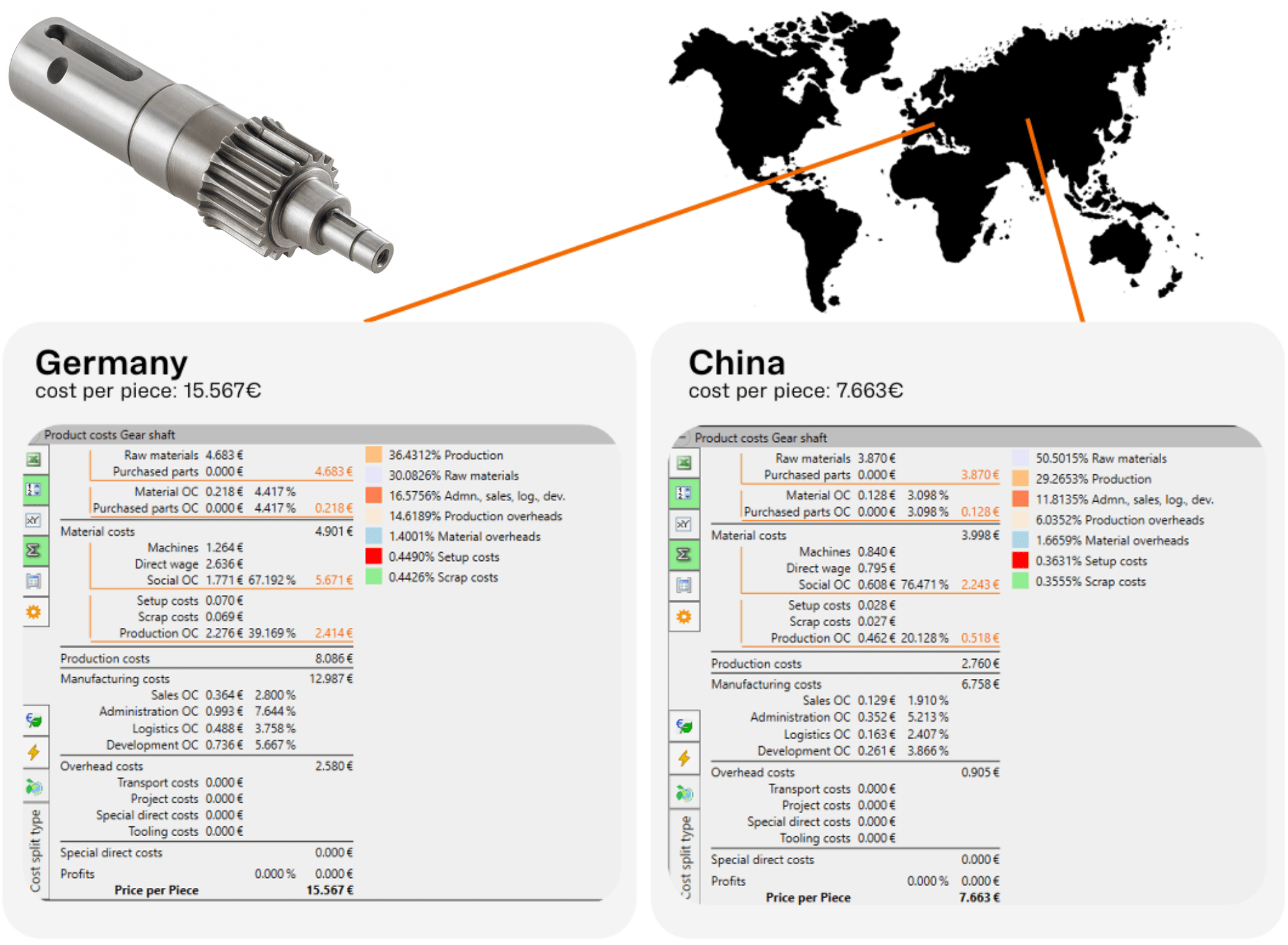
Location analysis for the cost-efficient production of a mechanically machined casting
Production costs vary considerably between locations. Wages and salaries differ depending on the country and region, as do location factors such as land and energy costs.
These influencing factors must be systematically taken into account when considering relocation or make-or-buy decisions. A lack of data leads to avoidable additional costs in the long term.
A first-tier supplier therefore analyzes in which region of the world a particular cast part with mechanical processing can be manufactured most economically, taking into account the total cost of ownership (TCO).
Software features
Success through innovation
Increase and optimize success with costdata® calculation - the comprehensive solution that promotes transparency and efficiency in your company.
Privacy
costdata® has no insight into your data - it remains local on your system. No outsourcing to external data centers.
Multilingualism
From English to Chinese - our software enables communication in your language and connects international markets.
Reportings
From PDFs to custom formats. Share information efficiently and make informed decisions.
Regular updates
We implement constant improvements so that you are always up to date.
Working together
Share calculations & data in common databases. Encourage knowledge sharing within your team.
Data included
Use the included costdata® market data to make data-driven decisions and gain comprehensive insight into the market.
Try costdata® estimation now
But would you rather have a quick estimate than a detailed full-cost calculation?
In the age of AI, speed is key. With costdata® estimation, you can get a well-founded cost estimate in just a few seconds—powered by AI and based on real costdata benchmark data. It’s ideal when a detailed full-cost calculation using costdata® calculation isn’t necessary, but you need a reliable initial cost estimate quickly.
Support
Frequently asked questions
Which products and components can I price using costdata® calculation?
With costdata® calculation, you can perform detailed cost estimates for components, assemblies, products, and tools. The software supports a wide range of manufacturing processes, including casting, injection molding, stamping, milling, turning, welding, coating, and assembly.
What data is already included in costdata® calculation?
costdata® calculation draws directly on extensive costdata® market data. This includes, among other things, up-to-date benchmark data on materials, wages, machinery, social costs, and overhead costs. As a result, there is no need to spend time researching and maintaining key costing data yourself.
Can I also use my own data for my calculations?
Yes. costdata® calculation enables a detailed should-cost analysis. This allows calculated product costs to be compared with supplier prices, variances to be identified, and individual cost drivers to be traced. This creates a solid foundation for price negotiations.
Can I compare supplier prices with the calculated costs?
Yes. costdata® calculation enables a detailed should-cost analysis. This allows calculated product costs to be compared with supplier prices, variances to be identified, and individual cost drivers to be traced. This creates a solid foundation for price negotiations.
Can I compare different production sites?
Yes. The location analysis allows for the comparison of different production sites and regions. Among other factors, it takes into account regional differences in wages, machinery costs, energy costs, and other location-related expenses.
Can I compare different pricing scenarios?
Yes. You can change parameters such as materials, machines, manufacturing processes, production volumes, or locations and analyze their impact on product costs. This allows you to quickly evaluate alternative scenarios and potential cost savings.
What sets costdata® calculation apart from a cost estimate created in Excel?
costdata® calculation combines professional product cost calculation with integrated market and benchmark data. Instead of having to set up and maintain calculation logic, data sources, and updates in individual Excel files themselves, users work in a centralized and structured calculation environment. Calculations can also be shared within the team, ensuring that knowledge is preserved within the company over the long term.
Do I need cost engineering experience to use costdata® calculation?
A basic understanding of product cost accounting is helpful, especially for complex analyses. However, the intuitive user interface, integrated data, and support features make it easy to get started. We also offer training courses to help users become familiar with the software and its capabilities.
What is the difference between costdata® calculation and costdata® estimation?
costdata® calculation is designed for detailed bottom-up cost calculations and offers users extensive options for analyzing and adjusting individual cost components, processes, and parameters on their own.
costdata® estimation takes a more automated approach and helps users arrive at an initial, reliable cost estimate more quickly. Which solution is more suitable depends primarily on the desired level of detail and the specific use case.
costdata® estimation takes a more automated approach and helps users arrive at an initial, reliable cost estimate more quickly. Which solution is more suitable depends primarily on the desired level of detail and the specific use case.
Can my calculations and company data be viewed in costdata®?
No. Your calculations and company data remain stored locally on your system. costdata® has no access to your confidential calculation data and does not store it in external data centers.
Is there any training on the software?
Yes, there is a training of the software that is offered together with the product. It can be ordered flexibly to meet the individual needs and requirements of the users. This training makes it easier to get started using the software and helps users realize its full potential.
What languages does the software support?
The software is offered in the following languages:
- German
- English
- French
- Spanish
- Italian
- Chinese
- Japanese
- Korean
- Turkish
- Portuguese
- Dutch
- Hungarian
Do I need administrator rights for the installation?
No, administrator rights are not required. The installation can be done directly and takes less than 5 minutes.