Commodity Price Tracking
Percentage price developments for your negotiating success
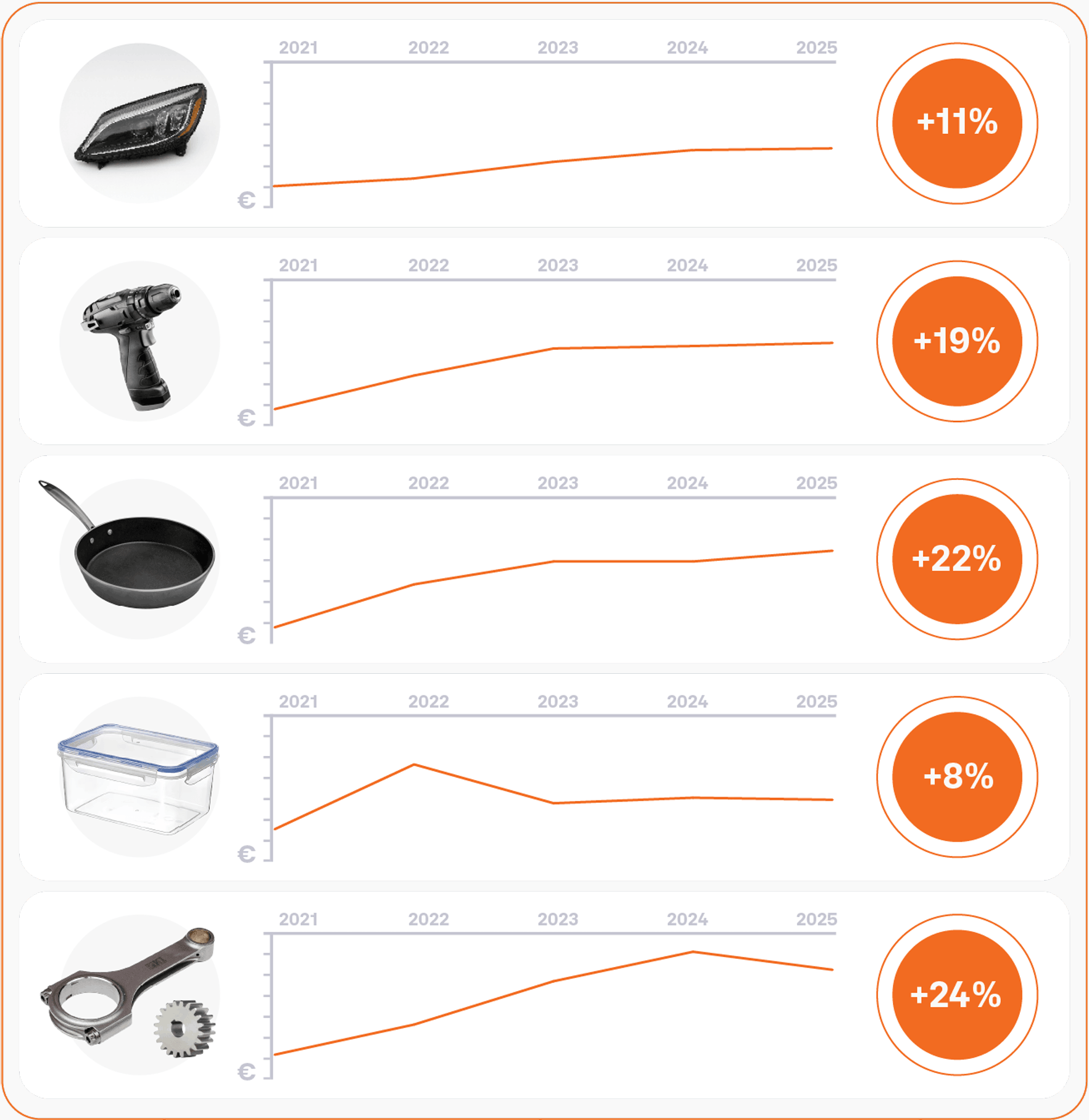
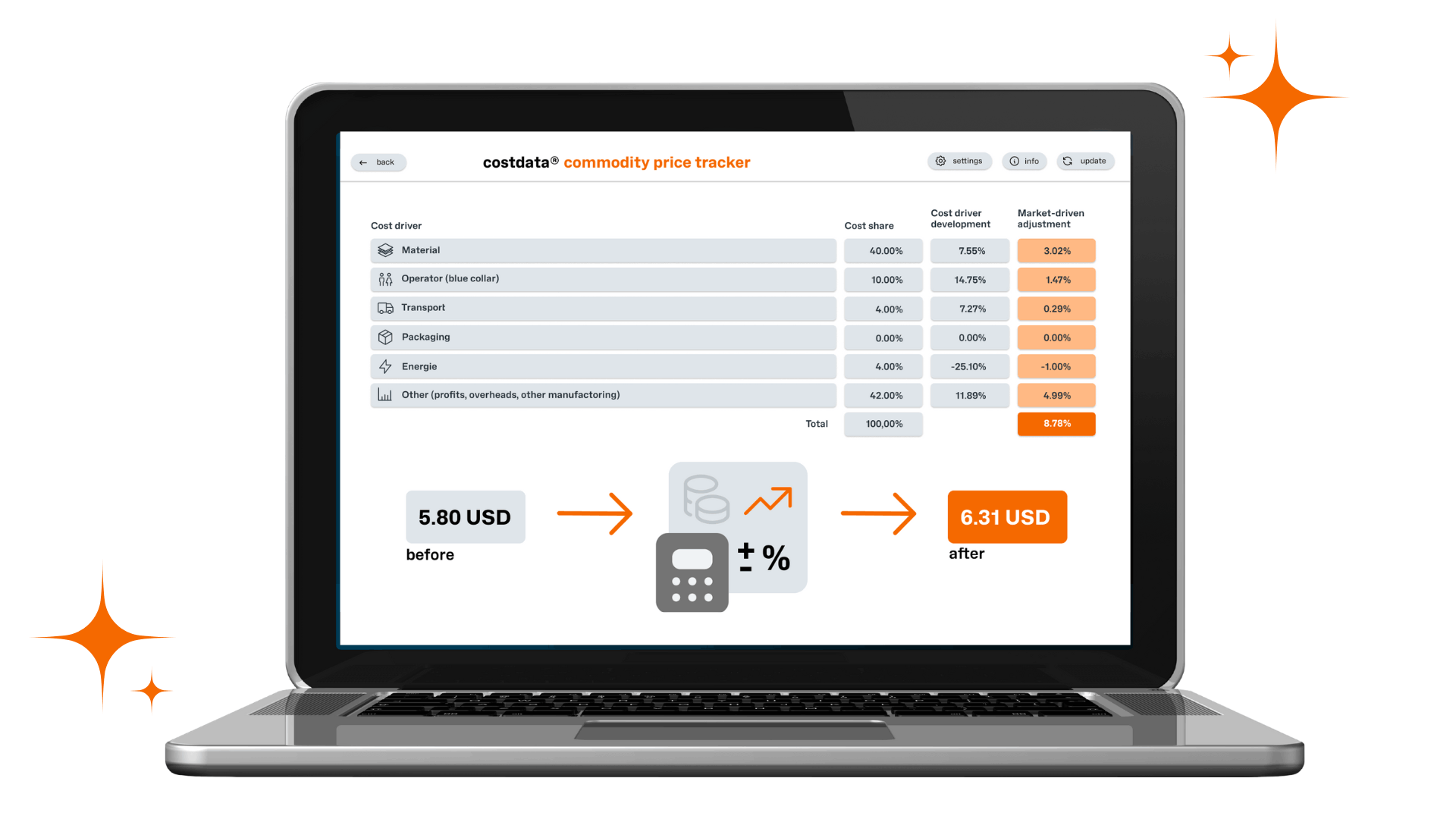
The costdata® Commodity Price Tracker uses historical data and detailed cost trends to enable precise cost structure analyses. Whether you’re looking at individual products or entire product groups, at the end of the analysis you’ll see at a glance the percentage change in total costs—whether they’ve gone up or down.
Quality and reliability for top companies










.svg)

















Our areas of application in the manufacturing industry
Discover the cost drivers of your products
How can you check whether a price increase from your supplier is really justified?
Why use the costdata® commodity price tracker?
The costdata® commodity price tracker gives you full transparency about the development of your cost structures.
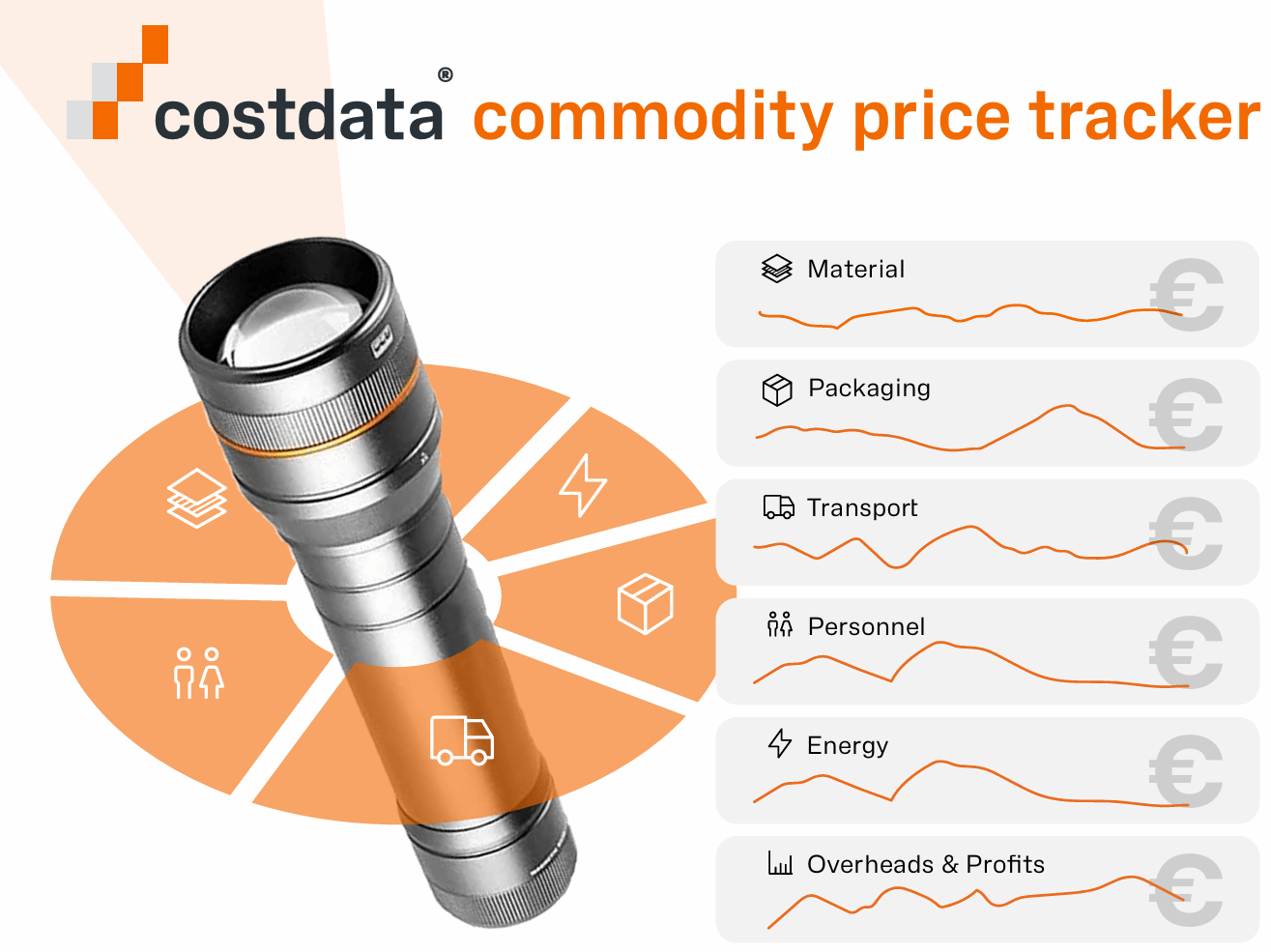
Our tool is based on current benchmark data and shows you exactly how individual cost drivers - such as material, energy, personnel, packaging, transport or overheads - have changed over time. This allows you to understand whether a price increase is justified, underpin your negotiation strategy with facts and make market-driven decisions.
Strengthen your negotiating position and uncover potential savings in price negotiations.
Our tool is based on current benchmark data and shows you exactly how individual cost drivers - such as material, energy, personnel, packaging, transport or overheads - have changed over time. This allows you to understand whether a price increase is justified, underpin your negotiation strategy with facts and make market-driven decisions.
Strengthen your negotiating position and uncover potential savings in price negotiations.
Cost transparency
Comprehensible price dynamics
Strong arguments in negotiations

Assortment analysis of drills to identify overpriced brand-name products
A hardware store purchases drills from various brands, whose prices vary greatly. The category manager is aware that some brands sell better due to their image. Nevertheless, the purchasing team questions whether the price premiums are actually justified.
With the help of CPT, they gain an overview of the development of relevant commodity prices in recent years. The analysis shows that two manufacturers offer their products at prices significantly above the market level, even though this price development cannot be explained by the underlying commodity markets.
The consequence: these suppliers are removed from the product range.
With the help of CPT, they gain an overview of the development of relevant commodity prices in recent years. The analysis shows that two manufacturers offer their products at prices significantly above the market level, even though this price development cannot be explained by the underlying commodity markets.
The consequence: these suppliers are removed from the product range.

Monitoring commodity price trends for the production of household appliances
A manufacturer of household appliances uses the CPT to continuously track price developments of commodities relevant to its own production.
Transparency about market trends shows the purchasing team when it makes sense to question and renegotiate the prices of individual components in the bill of materials (BOM).
Information is obtained quickly and efficiently, as the CPT does not require complex bottom-up calculations, but enables realistic estimates to be made in a short time.
Transparency about market trends shows the purchasing team when it makes sense to question and renegotiate the prices of individual components in the bill of materials (BOM).
Information is obtained quickly and efficiently, as the CPT does not require complex bottom-up calculations, but enables realistic estimates to be made in a short time.

Market price review of electronic products to support supplier negotiations
A manufacturer of household appliances uses the CPT to continuously track price developments of commodities relevant to its own production.
Transparency about market trends shows the purchasing team when it makes sense to question and renegotiate the prices of individual components in the bill of materials (BOM).
Information is obtained quickly and efficiently, as the CPT does not require complex bottom-up calculations, but enables realistic estimates to be made in a short time.
Transparency about market trends shows the purchasing team when it makes sense to question and renegotiate the prices of individual components in the bill of materials (BOM).
Information is obtained quickly and efficiently, as the CPT does not require complex bottom-up calculations, but enables realistic estimates to be made in a short time.

Optimization of an industrial company's pricing strategy through cost-based pricing
A medium-sized industrial company is growing steadily. The business intelligence team is therefore pursuing the goal of creating more transparency in the company-wide pricing strategy and analyzing a cost-based pricing approach.
To this end, the commercial excellence team uses CPT to track category insights and price developments. This makes those responsible for pricing less dependent on short-term market fluctuations and allows them to focus more on realistic manufacturing costs.
On this basis, target margins can be systematically calculated and added to product prices.
To this end, the commercial excellence team uses CPT to track category insights and price developments. This makes those responsible for pricing less dependent on short-term market fluctuations and allows them to focus more on realistic manufacturing costs.
On this basis, target margins can be systematically calculated and added to product prices.
Market-leading database
Based on our benchmark data
Well-founded as never before: All calculations are based on the unique costdata® market data - your guarantee for market transparency and comparability.
Agricultural products
Metals
Construction materials
Floor space costs
Chemistry
Raw materials
Electronics
Standard components
Salaries
Social data
Overheads
Location factors
Plastics
Textiles
Wages
Packaging
Machines
Currencies
Our new power tool - products & product groups
The process for targeted price tracking.

.png)
.png)
.png)